How much milk the analysis uses, what happens behind the scenes, why we ask for a 24-hour pooled baseline sample, and what the research says about how breast milk fat, protein, and carbohydrate change over a day.
You are eagerly awaiting your nutritional analysis to arrive in your inbox from Milkify Medical, and are excited to see all the cool stats about your breast milk. Meanwhile, your mind may be buzzing with curious questions about what our milk analysis process for MOM Fortification* entails, and what to anticipate on your report.
Here, we'll break down the top questions we receive about our milk macronutrient analysis process from customers who plan to use their own freeze-dried milk for their babies' targeted caloric fortification (aka “MOM Fortification”).
If I place an order for MOM Fortification, what would the nutritional analysis part of my order include?
Your order would include two macronutrient analyses: one on your baseline (liquid) breast milk, and one on your freeze-dried breast milk powder. These analyses would be used by our medical team to create your custom recipe for MOM Fortification. For each analysis, we use the Miris Human Milk Analyzer, which is also relied on by many hospitals to analyze breast milk nutritional content.
Would I have to sacrifice much of the milk I intended to use for my baby for the sake of the analysis?
No. The good news is we use only a modest amount – just 1 to 1.5 fluid ounces (30-45 mL) of frozen milk – for a liquid milk baseline sample analysis, and approximately 1 gram of a client's freeze-dried milk (equivalent to approximately ¼ ounce of reconstituted breast milk powder) for the powder sample analysis. The small amount of milk that is used for analysis must then be discarded.
When you receive a shipping kit from Milkify Medical, it will contain a small tube for collecting a pooled sample of your baseline milk for analysis, to be sent in alongside your breast milk intended for freeze-drying. To collect the baseline sample, you would pool freshly pumped milk from a 24-hour period, mix, and then pour 1 to 1.5 fluid ounces (30-45 mL) of it into the small tube that we provided. After freezing it, you'll then ship the frozen tube of baseline milk to us, along with your other frozen milk intended for freeze-drying. (Any remaining pooled milk can be used however you would like.)
Later, when your freeze-dried MOM Fortification order is being packaged at our facility, a sample of your freeze-dried breast milk powder would be collected by the Milkify Medical team for a separate Miris analysis.
What would happen behind the scenes at Milkify Medical to complete my milk analysis?
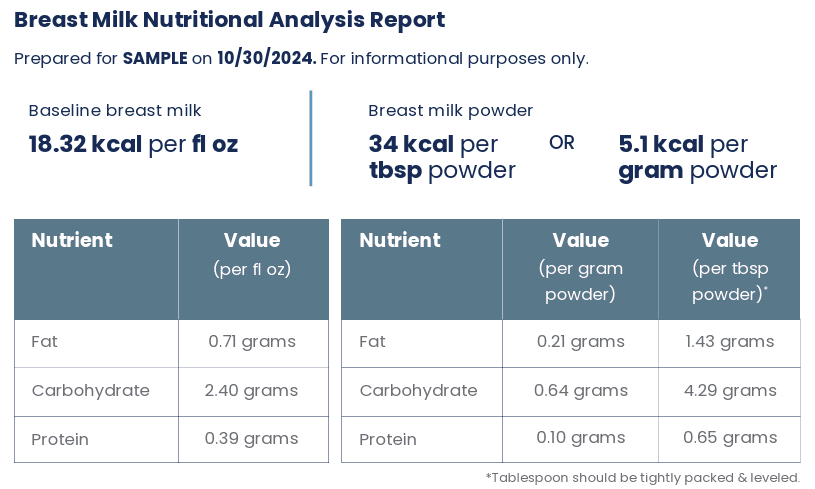
First, we freeze-dry all the frozen milk in your order (with the exception of your baseline sample tube, of course). Then, during the packaging process, we collect a 1 gram sample of freeze-dried breast milk powder, pooled from 5-10 individual lactation bags. Once the powder sample has been collected from your order, we rehydrate the powder sample to liquid milk, and thaw the frozen baseline sample. Then, both samples are run on the Miris, which reports values for macronutrients – fat, protein, and carbohydrates expressed in grams/100mL – as well as calories or energy.
So would I receive multiple milk analysis reports or just one?
You would receive one report per order that shows the macronutrient values of your baseline milk samples (liquid milk), and the macronutrient values of your powder sample (freeze-dried milk). In addition, our clinical team would supply you with an individual, custom fortification recipe that meets your infant's target caloric goals, using data from the analysis to create the recipe.
Why do I have to collect and pool milk over a 24-hour period for the baseline sample? Why not just use milk from one pump session?
By pooling freshly expressed milk from a 24-hour period for the baseline sample analysis, this helps us better account for variability in breast milk composition over the course of a day. This 24-hour pooled milk methodology is also common practice in NICUs across the globe who do targeted fortification for their inpatient babies.
Note: the Miris Human Milk Analyzer will measure total calories, fat, carbohydrate, and protein – not give more detailed information about the individual types of fat, types of carbohydrate, or types of protein.
What does research show with regard to which macronutrients can vary over a 24-hour period?
Looking at total carbohydrate and protein values in breast milk:
According to a 2020 systematic review in Nutrients journal on which human milk components vary over a 24-hour (“circadian”) period for breastfeeding mothers, carbohydrates show no conclusive circadian variation.
On the other hand, proteins showed some circadian variation (i.e. variation within a 24-hour period) for individual amino acids within breast milk, but no circadian variation for total protein within the milk. For example, the individual amino acid tryptophan in breast milk is typically higher at night than earlier in the day. That's the same ingredient in turkeys that may partially contribute to feeling like you need a nap after a big Thanksgiving turkey meal. Tryptophan may also help a breastfed baby feel relaxed and sleepy at night.
That said, over the course of a breastfeeding journey, the total protein in breast milk gradually goes down, according to an article that appeared in a 2020 issue of Clinical and Experimental Pediatrics. For example, total protein starts out high in colostrum in the first 1-5 days and then by 14+ days postpartum in mature milk it decreases modestly, and then it dips a tad more after 6 months to accommodate the growing baby's changing protein needs. So if your baby needs targeted caloric fortification long-term, your medical team may recommend doing additional baseline analysis for us periodically to ensure the targeted caloric fortification recipe is up-to-date.
Looking at total fat values in breast milk:
A systematic review in Nutrients journal revealed that total fats (…including triacylglycerols – which “make up more than 95% of total lipids”, and also cholesterol) show some circadian variation (i.e. variation within a 24-hour period), which is also supported by other sources.
Typically, breast milk fat values are highest in the evenings (at least for moms who sleep during the nighttime), while their breast milk fat values are lower in the mornings. This may be why babies who feed at the breast typically cluster feed in the evening (snack and snack and snack at the breast) to load up on the high-calorie, fatty milk before their nighttime bedtime. Total fat at a breast-pumping moment in time also varies depending on how “empty” a breast is, with an emptier breast (such as toward the tail end of a pumping session) making more fatty milk than a breast that is fuller.
Research done by a Stanford/Packard Children's team revealed the total fat value (and therefore total calories) in pumped milk can also vary depending on whether or not mothers using a double-electric pump did gentle breast compressions along with pumping and did some hand expression afterward. Doing both activities can add up to fattier milk, and can be learned by watching this video.
The bottom line
So in other words, the total fat in breast milk can be highly variable over the course of a day, while protein and total carbohydrate content within the same day – not so much. And fat is high in calories, so it has the most impact on total calories in breast milk, in comparison to the other two macronutrients. Equipping us with a 24-hour pooled baseline sample for macronutrient analysis enables us to provide you with an accurate picture of average energy values in your baseline milk throughout the course of a day.
Have more questions about Miris analysis or MOM Fortification?
Our trained and compassionate team is happy to help! We want this to be as straightforward of a process as we can for you during this busy and possibly very stressful season in your family's life. You can request information via our website form here. Or, simply email us at info@milkify.me with your questions.
*What is Milkify Medical “MOM Fortification”?
Milkify Medical's MOM Fortification program offers 100% human milk-based caloric fortification for infants greater than 1800g (4 pounds) using the mother's own surplus freeze-dried breast milk as a caloric fortifier for freshly expressed breast milk. Parents may choose MOM Fortification out of a desire to support their baby's growth while providing exclusively their own breast milk, and avoiding the tolerance issues that can sometimes be associated with cow's milk based formulas and fortifiers.
How does it work?
After placing an order through Milkify Medical and doing a consultation with our medical team, parents send a portion of their surplus frozen breast milk to Milkify, using one of our provided overnight shipping kits. Once received, the milk is freeze-dried, and samples of both liquid and freeze-dried breast milk are analyzed for macronutrient composition using the FDA-approved Miris Human Milk Analyzer.
The macronutrient analysis is then used by Milkify Medical's clinical team to develop an individualized fortification recipe guide to meet the caloric goals set by the infant's care team. The freeze-dried breast milk is then returned to the family along with the custom recipe and equipment for precise measurement of freeze-dried breast milk powder. The freeze-dried powder can then be easily mixed into the mother's own liquid breast milk according to the custom recipe guide in order to provide her baby with 100% Mom's Own Milk.
Learn more
See how the program works from consult to custom recipe, and what your baby's care team needs to get started.
About MOM Fortification→References
- Circadian Variation in Human Milk Composition, a Systematic Review – PMC
- Combining hand techniques with electric pumping increases the caloric content of milk in mothers of preterm infants – Journal of Perinatology
- Components of human breast milk: from macronutrient to microbiome and microRNA – PMC
- Differences in pumping affect breast milk's nutritional value – Stanford Medicine News Center
- Maximizing Milk Production with Hands-On Pumping – Stanford Medicine
- MOM Fortification Program: How It Works – Milkify Medical
- Miris: NICUs
- What affects the amount of fat or calories in mom's milk? – KellyMom.com
About the authors: Lauren Figard, Ph.D., is Chief Quality Officer for Milkify and Milkify Medical. Karen Miles is an International Board Certified Lactation Consultant (IBCLC) and Lactation Content Specialist with Milkify.
This blog is for informational purposes only and is not intended to diagnose, treat, or be a substitute for medical advice. Please consult with your healthcare provider for any questions you may have related to your own health, or your baby's health, and do not change your baby's feeding plan without the recommendation of your baby's healthcare team. If you wish to request information about Milkify Medical MOM Fortification to give to your clinician to review, click here.
Have questions about MOM fortification?
Our medical team works with families and providers to build an individualized plan.
Request Info