Freeze-dried breast milk is not pasteurized and not sterile. Here is what Milkify Medical does in the facility, and what parents, caregivers, and providers can do at home, to keep MOM Fortification powder safe for medically fragile babies.
Whether the activity be…
- a parent thoroughly washing and drying pump parts before the next breast pump session,
- Milkify Medical performing quality control testing on freeze-dried breast milk,
- or a healthcare provider or caregiver washing hands before serving a baby a bottle of reconstituted breast milk
… safety measures matter when it comes to preparing freeze-dried milk for babies.
How can everyone – Milkify Medical, parents, caregivers, and the healthcare team – ensure the utmost safety of freeze-dried breast milk that is used for caloric MOM Fortification* of a medically fragile baby?
What Milkify Medical does to prevent bacterial contamination of freeze-dried breast milk
1. We operate in a cGMP-certified facility.
Safety is number one at Milkify. Milkify is an FDA-registered and cGMP-certified facility. This stands for “current Good Manufacturing Practices,” which is a set of safety and quality standards established by the FDA, covering such topics as personal hygiene, facility design, equipment maintenance, cleanliness, sanitation, recordkeeping, and safety controls during processing.
2. To reduce the risk of bacterial growth and contamination, our process is designed to be contact-free.
This means that each customer's milk is freeze-dried directly in one of our proprietary freeze-drying pouches, using our patented SafeDry Freeze-Drying Process. The milk is not directly touched by human hands, equipment or utensils. And it is never co-mingled with other people's milk. Milkify's technicians only process and package one customer order at a time, and customer orders are loaded onto separate trays in the freeze-dryer. Additionally, each bag of milk is labeled with the customer's name at all times – even while in the freeze-dryer!
To prevent microbial growth, the milk is never fully thawed. It remains frozen until it is turned into powdered form. A trained technician carefully packages each customer's freeze-dried breast milk under an ISO 5 laminar-flow hood, which is an enclosed space that provides HEPA-filtered airflow to prevent contamination from the environment.
Why are these safety measures so important? Freeze-dried breast milk is not pasteurized, and is not sterile. Expressed breast milk contains some amount of natural flora, including bacteria from the mother's skin and potentially from the pump or pumping environment. Our safety measures are carefully designed to prevent excess growth of these bacteria, or introduction of any additional contamination. And of course, extra caution always comes with feeding medically fragile babies. (If you're wondering, powdered formula is also not sterile.)
3. We do water activity testing on every order of freeze-dried breast milk.
Before shipping freeze-dried milk back to a given customer, a technician measures the water activity (“dryness”) of the breast milk powder, using an AQUALAB 3 water activity meter, to make sure it can be preserved and used for up to three years in our packaging.
“The AQUALAB 3 was one of the very first purchases we made as a company.”
Water activity is the critical determinant of shelf stability – if it is too high, it can lead to a risk of microbial growth. Confirming that moisture has been removed to exacting standards is what allows us to stand behind a shelf life of up to three years – no refrigeration required when stored properly in a cool, dry place.
4. Our freeze-drying process reduces any bacteria from the mother's own milk.
In order to preserve as much of the beneficial macronutrients and probiotics as possible that were inherent in the original frozen breast milk, we don't pasteurize freeze-dried milk intended for MOM Fortification. Therefore, doing all we can to control microbial growth without pasteurization is top priority to us at Milkify Medical.
A recent in-house study at Milkify looked at how the bacterial load in freeze-dried breast milk powder compares to frozen breast milk. The result? Freeze-drying reduced the total bacterial load by approximately 90%. Although this is much more modest than the reduction that would be expected from pasteurization, the result provides a level of reassurance to customers that freeze-dried milk likely contains less bacteria than it did before freeze-drying. Additionally,
“Even in the instance of some bacterial survival after freeze-drying … no bacterial growth is possible during long-term storage of the powder when proper water activity controls and packaging is used.”
These are just a handful of examples of all the ways that the Milkify Medical team takes safe handling of human milk very seriously. But that's just one component of freeze-dried breast milk safety. Parents and caregivers play a role in the safety of freeze-dried milk, too.
What parents and caregivers can do to minimize risk of bacterial contamination of freeze-dried breast milk
(If you are a healthcare provider, share this info with the parents you serve.)
1. Check freezer and fridge temperatures.
Safe temperatures help halt bacteria growth. According to the U.S. Centers for Disease Control and Prevention (CDC), for breast milk storage in a refrigerator or freezer, “Your refrigerator should be 40°F or below, and your freezer should be 0°F or below.” If you don't see the temperatures on your refrigerator and freezer thermostats, the CDC and the U.S. Food & Drug Administration (FDA) both recommend getting an inexpensive, freestanding appliance thermometer to determine the temperature.
2. Wash hands before expressing milk, and right before feeding the baby.
If handling or reconstituting a bottle of freeze-dried breast milk with unwashed hands, it is unfortunately easy for parents and caregivers to pass along pathogens that they unknowingly came into contact with earlier in the day. The same goes for pumping, as that also involves preparing food for a baby.
To avoid this, always wash with soap and water for at least 20 seconds before pumping or feeding times. Ideally, get a good lather going each time you wash, including also the backs of your hands and under fingernails. But if soap and water are not available when on-the-go, alcohol-based hand sanitizer will suffice in a pinch. Just make sure the alcohol-based hand sanitizer contains at least 60% alcohol, warns the CDC.
3. Clean and dry, or not? Check breast milk collection containers & pump parts.
After using the pump each time:
a) Fully disassemble all collection bottles and pump parts
Including duck bills, membranes, connectors – everything that can be taken apart. Taking the time to separate duck bills and pump membranes in particular can easily be forgotten, and then lead to unwanted buildup of milk and bacteria. Place all the parts in a large, clean bowl or clean wash basin that is only used for breast pump parts.
b) Wash collection bottles and pump parts with warm, soapy water
Then place on a clean towel or drying rack. When washing by hand, use a scrub brush that is only dedicated to washing pump parts – not one that doubles as a tool for cleaning food off plates, for example. Note: If the pump has tubing, it does not need washing – “unless it comes in contact with breast milk,” says the FDA.
Keep in mind: The “fridge hack” circulating online of throwing unwashed pump parts into a Ziploc bag and into the refrigerator between pump sessions is NOT wise for medically fragile or preterm babies. This is because bacteria can grow on unwashed pump parts, even in the refrigerator, and medically fragile babies are particularly vulnerable.
c) Make sure the pump parts are dry before the next time pumping
If not, hand-dry as thoroughly as you can with a clean fabric or paper towel. (This is where purchasing two or more sets of breast milk collection containers and pump parts can be a big time-saver.) Remember: Bacteria thrive in moist environments, so taking the time to ensure the parts are dry really can make a difference.
d) Examine pump parts for microtears or signs of mold
Replace those parts before pumping. This is another occasion where purchasing backup pump parts to have on hand can come in handy.
4. Add a pump parts sanitizing/sterilization step – at least once daily (or as often as the baby's healthcare provider recommends).
Using one of these methods – a sterilizer, a plug-in steam system, or boiling the pump parts – once daily removes microscopic bacteria that simply washing by hand may not remove.
To boil, place items into a pot and cover with water. Bring to a full boil for 5 minutes and remove with tongs. Then, air-dry the items on a clean fabric or paper towel.
According to the CDC, “Sanitizing is especially important if your baby is less than 2 months old, was born prematurely, or has a weakened immune system (such as chemotherapy for cancer).”
5. Freeze breast milk as soon as possible after expressing it, if it is going to be used for freeze-drying.
Putting breast milk in the freezer helps slow bacterial growth better than refrigeration.
But if a parent or caregiver wants to put freshly expressed breast milk directly into the refrigerator first – in case it is needed for a feeding within four days at most of pumping it – rest assured, that does fall within the CDC's established breast milk storage guidelines. Keep in mind though, the amazing bactericidal (bacteria-killing) capacity of human milk, when refrigerated, “declines significantly by 48-72 hours,” according to one Academy of Breastfeeding Medicine protocol.
The moral of the story? The sooner the breast milk goes into the freezer (instead of the fridge), the better, for any expressed milk not intended to be fed to the baby within a short window.
6. Keep freeze-dried milk in a temperature-controlled environment whenever possible.
After milk has been freeze-dried, proper storage at home is essential. For prolonged storage of MOM Fortification powder, avoid unsteady temperature environments (such as a garage, or outdoors for a weekend or more of camping). A cool place indoors is best for long-term storage of freeze-dried breast milk.
With these steps in place, together we can help ensure the little ones we serve receive the safe, caloric fortification they need to grow and thrive.
*What is Milkify Medical “MOM Fortification”?
Milkify Medical's MOM Fortification program offers 100% human milk-based caloric fortification for infants greater than 1800g (4 pounds) using the mother's own surplus freeze-dried breast milk as a caloric fortifier for freshly expressed breast milk. Parents may choose MOM Fortification out of a desire to support their baby's growth while providing exclusively their own breast milk, and avoiding the tolerance issues that can sometimes be associated with cow's milk based formulas and fortifiers.
How does it work?
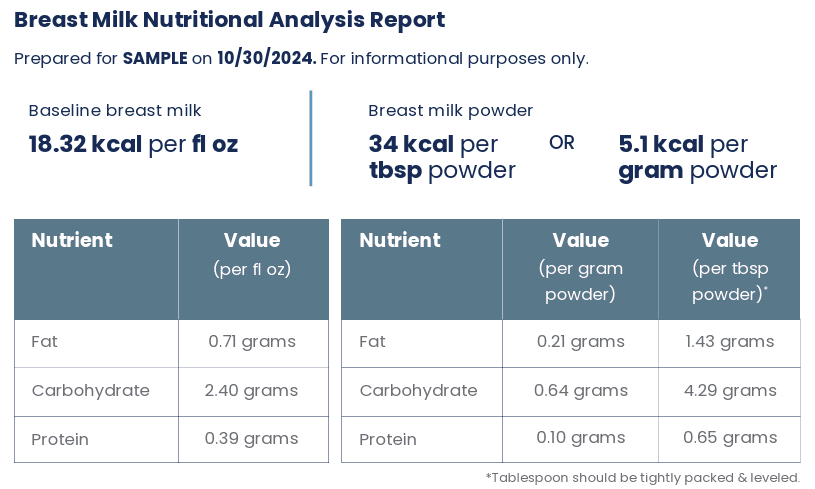
After placing an order through Milkify Medical and doing a consultation with our medical team, parents send a portion of their surplus frozen breast milk to Milkify, using one of our provided overnight shipping kits. Once received, the milk is freeze-dried, and samples of both liquid and freeze-dried breast milk are analyzed for macronutrient composition using the FDA-approved Miris Human Milk Analyzer.
The macronutrient analysis is then used by Milkify Medical's clinical team to develop an individualized fortification recipe guide to meet the caloric goals set by the infant's care team. The freeze-dried breast milk is then returned to the family along with the custom recipe and equipment for precise measurement of freeze-dried breast milk powder. The freeze-dried powder can then be easily mixed into the mother's own liquid breast milk according to the custom recipe guide in order to provide her baby with 100% Mom's Own Milk.
Learn more
See how the program works from consult to custom recipe, and what your baby's care team needs to get started.
About MOM Fortification→References
- About Handwashing | Clean Hands | CDC
- ABM Clinical Protocol #8: Human Milk Storage Information for Home Use for Full-Term Infants, Revised 2017 | Academy of Breastfeeding Medicine
- Breast Milk Storage and Preparation | Breastfeeding | CDC
- Breast Milk Storage Questions and Answers | Breastfeeding | CDC
- Cleaning a Breast Pump | FDA
- Current Good Manufacturing Practices (CGMPs) for Food and Dietary Supplements | FDA
- How to Clean and Sanitize Breast Pumps | Water, Sanitation, and Environmentally Related Hygiene (WASH) | CDC
- Milkify Medical — MOM Fortification
- Milk Storage Guidelines | American Academy of Pediatrics
- Refrigerator Thermometers – Cold Facts about Food Safety | FDA
- The Drip by AQUALAB | Episode 30: Milkify
About the authors: Lauren Figard, Ph.D., is Chief Quality Officer for Milkify and Milkify Medical. Karen Miles is an International Board Certified Lactation Consultant (IBCLC) and Lactation Content Specialist with Milkify.
This blog is for informational purposes only and is not intended to diagnose, treat, or be a substitute for medical advice. Please consult with your healthcare provider for any questions you may have related to your own health, or your baby's health, and do not change your baby's feeding plan without the recommendation of your baby's healthcare team. If you wish to request information about Milkify Medical MOM Fortification to give to your clinician to review, click here.
Have questions about MOM fortification?
Our medical team works with families and providers to build an individualized plan.
Request Info