Your baby's provider has approved MOM Fortification, and now you need to pump a little more than your baby takes each day. These ten practical, lactation-consultant-tested ideas can help you get there.
Let's say you just received the go-ahead from your baby's healthcare provider to use your own freeze-dried breast milk powder from Milkify Medical for caloric fortification. Your baby's provider has told you that your sweetie needs additional calories to grow, and you would prefer not to use formula or cow-milk based fortifier for that purpose due to its potential for tolerance issues. Plus, you are well aware of breast milk's many amazing attributes and love the idea of providing 100% your own breast milk during this season in your baby's life.
But the math may feel a bit intimidating. Parents typically need to produce “somewhere between 20% to 30% more breast milk, on average, than their baby takes each day in order to set aside enough to freeze-dry their own milk for caloric fortification,” shares Laura Serke, dietitian and client support for Milkify Medical.
“For example, most human milk averages at 20 calories per ounce. If a baby's provider sets a target value of 24 calories per ounce for growth instead of the mother's 20 calories per ounce, then the mom needs to pump approximately 20% more milk than her baby's baseline daily intake. Let's say that the baby already consumes 600 milliliters (20 ounces) of pumped breast milk in a day. Then the mom would need to pump an extra 120 milliliters (approximately 4 ounces) per day beyond what she is already producing.”
Does the milk volume needed for the caloric fortification goal that you've been given by your baby's care team sound challenging to reach? We've got you covered with plenty of ideas for ways to maximize your breast milk output for MOM Fortification*.
1. Determine: Keep or replace your breast pump and pump accessories?
Many breast pump manufacturers have a warranty of just one to two years on their pumps. If you have an older child that you previously pumped for and now are using that personal pump for baby number two, it is likely time to retire it. When too much time has passed, the pump motor may become less effective to yield a good output. And you want your time at the pump to count!
If you're ready to part with your pump, search your pump manufacturer's website for warranty length and whether or not they have a pump recycling program. Then, if you can only get one pump (through your insurance or a purchase), opt for a new, bilateral electric pump (also called a “double electric pump”). Make sure it is one with plug-in-the-wall capability. That will typically net more milk output for time spent than a rechargeable wearable pump or a single-side only pump (including manual or “hand” pumps).
And if you find yourself struggling with milk output when using a new, personal, bilateral electric pump that is plugged in, here's a great alternative to try: Check with your local hospital, lactation clinic, WIC program, or community parent-support organization to see if they have a multi-user “hospital-grade rental pump” – one with a durable, powerful motor that you can use short or long-term until your milk supply is where you want it. For some parents, a hospital-grade rental pump can add up to even better milk output than any personal-use pump.
In addition, keep in mind that pump accessories such as tubing, membranes, or duck bills can wear out quickly – in as little as weeks or a few months depending on the pump part, manufacturer, and frequency of use. And little micro-tears or stretching of pump accessories can add up to less effective pumping. So keep extra pump accessories on hand for when it is time to swap out for new ones (or earlier than that, if a tear, visible stretching, or mold occurs). Check your pump manufacturer's website for recommendations on how often to replace your pump parts/accessories.
2. Get to know your pump settings.
There is typically one setting for the suction strength and another for speed. Understanding what the settings are mirroring in a breastfeeding relationship can help you better navigate when to turn up or down your pump's dials or touch controls.
I love how my Milkify colleague Laura Serke describes pump settings to pumping parents:
“When starting a pumping session, a setting with a lower strength, but faster pattern mimics baby ‘sip sip sipping’ to start the milk letdown. When the milk is flowing, a higher suction, but slower pattern mimics baby ‘sip-swallowing’ and continues the milk flow. If your milk flow slows down, you can try going back to a lighter, faster pattern. Remember, more suction doesn't always mean more milk if it causes pain, pinching, or irritation.”
3. Get a flange fit (or a re-fit, if it's been awhile).
You know, those cone-shaped things that contact your breasts when pumping? Find out whether or not they are sized appropriately to your breasts, nipples, and your level of nipple/areola elasticity at the current stage in your breastfeeding journey. It's a balance between comfort and output.
A flange fit is worth doing…
- If you have never had a flange fit before, or
- You already had a flange fit in the hospital on day one or two postpartum, but now weeks later you question whether the fit has changed (it may have). Perhaps you are experiencing some pain with pumping even on a gentle pump mode, or are not getting as much output as you used to get at the pump.
Ideally, schedule a flange fit visit with a lactation consultant (IBCLC), preferably one who has a wide array of flanges that are in different sizes, shapes (pano, saucer, conical, etc.), and materials (hard plastic vs. more flexible silicone flanges) that you can actually try on while pumping during the visit. Of course, be sure to bring your pump(s) along with you to the visit. That way, your consultant can measure your nipples and watch you pump in different flange sizes and types, to decide on the flanges that are most comfortable and net the most possible output for you. (Sometimes that means a different flange size for each breast!)
For some people, “pump inserts” are also needed to go inside the flanges to make them more snug if their measurement is between two available flange sizes. Your lactation consultant can advise if inserts are needed or not.
4. Increase daily pumping frequency.
The number of times you pump over each 24-hour period may have a direct impact on your total daily breast milk output. That's because milk output past the first few weeks postpartum is primarily milk-removal driven and not as much hormonally-driven as it was in the early days.
In addition, each mother's anatomy is different in terms of how many times a day milk removal is needed to maintain and not drop the milk supply. Lactation consultant Nancy Mohrbacher, IBCLC, RLC, FILCA, in a Clinical Lactation journal article, dubs it the “Magic Number” that is unique to each person.
Likewise, each person has a different “breast storage capacity” that impacts that magic number. Those with large storage capacities can remove milk fewer times a day and still maintain their supply, while those with smaller breast milk storage capacities have to remove milk more often to maintain their supply. (And if you are wondering, breast storage capacity is not related to breast size.)
So if you are just shy of getting where you need to be for caloric fortification of your breast milk with your own freeze-dried breast milk powder, and have the bandwidth to add another time or two at the pump each day – even if for just five minutes – consider doing so. Assuming you don't work the night shift, a good time to add an extra full or mini pump session is first thing in the morning early before the rest of your house is awake (or in the middle of the night, if you are up anyway). That's the time when prolactin, that lovely milk production hormone, is generally high.
5. Plan for some short-term power pumping.
Don't worry; heavy dumbbells are not required for this! Just a defined window of time for concentrated breast pumping. I know, more time at your pump is probably the last thing you are craving right now. But just a little increased pump use for a small portion of a day or two can net big gains for your future milk supply.
Besides working for Milkify Medical, my colleague Laura Serke works in a Level III NICU as a dietitian and lactation consultant. She recently shared with me:
“In the hospital I work for, we sometimes have parents try a 10 minutes on and 10 minutes off power hour to see if it increases their supply over the next few days. This mimics how a baby would cluster feed to take in more milk during a growth spurt.”
Remember: The goal with power pumping is not to fill up a hundred freezers with breast milk. You don't want to set yourself up for clogged ducts or mastitis due to over-the-top milk production. So limit the power pumping, for your own sanity and health. You just want to bump up your supply a bit to have enough extra milk for freeze-drying, plus maybe a little beyond that for emergencies or return to work outside the home, if needed.
6. Add light breast compressions with pumping.
Do this just before each time pumping to help you feel relaxed and encourage letdown. You can even do this during pumping to net even more milk!
Just be careful to use only gentle compressions or light sweeping of the skin – not deep massage or excessive force, cautions the Academy of Breastfeeding Medicine in one of their clinical protocols for healthcare providers. Likewise, they recommend not using any vibrating or massaging devices on the breast so as not to cause any inflammation or harm to breast tissue.
7. Hand-express milk for a few minutes after pumping.
If you haven't heard of hand expression before, it essentially involves drawing out breastmilk from your breasts, using only your hands and a catching device like a clean spoon or mug. Or a bowl, if you worry about milk splattering!
During hand expression (aka “manual expression”) of breast milk, your hands work in ways your pump can't exactly mirror, and so are a nice complement to pumping. Adding hand expression after pumping can make a big difference in overall breast milk yield, according to past research done by Dr. Jane Morton and colleagues.
If your pump kit comes with a flange (a funnel shape) that connects to a collection bottle, then you can use that setup after pumping as a hand expression “catching bowl”! Simply turn off your pump. Then, hand-express milk drops directly into your flange and collection bottle setup which are positioned below your breast.
An added bonus for your hand expression efforts? Hand expressed milk tends to consist of more fat than pumping alone does, to help your baby grow! A study published in the journal Breastfeeding Medicine looked at the milk of 21 mothers of newborns, using a human milk analyzer. The study revealed that “Manually expressed human milk had higher fat content than milk expressed by electric pump.”
Learn the steps to hand expression by reading this CDC how-to sheet. Or, watch this excellent NHS how-to video to learn how.
8. Spend some skin-to-skin time with your baby after feeds.
Also known as “kangaroo care,” it can help you de-stress and encourage oxytocin production, that love hormone that also helps with milk letdown! Plus, if you are trying to persuade your baby to do some direct breastfeeding, it makes the breast/chest easily accessible, with all the warmth and smells that may draw a baby to breastfeed.
A study involving 550 low birthweight (LBW) infants (1500-2250 g) and their mothers, reported on in a 2025 issue of The American Journal of Clinical Nutrition, showed those mother-babies who were encouraged and supported to practice skin-to-skin care “for as long as possible during the day and night, with the assistance of other family members” had “substantially higher human milk intake” (emphasis added) compared with low birthweight babies who were not encouraged to do skin-to-skin care.
Far from being only about snuggles and comfort, skin-to-skin time can help regulate your baby's body temperature and blood pressure, as well as serving as a breastfeeding tool.
9. Set the mood for milk.
Time at the pump can drag on, particularly if you're hooked up to a plug-in-the-wall pump multiple times a day. To help pass time, while at the same time encouraging relaxation and milk letdown, try these ideas:
- Consider swapping out scrolling newsfeeds on your cell for flipping through favorite pictures or videos of your sweet baby. Thinking about your baby, instead of something potentially stressful like bad news, may help you relax more which can promote milk letdown.
- Listen to relaxing music that calms your mind. A study covered in the Journal of Clinical & Diagnostic Research showed it can be effective not only at lowering cortisol for mothers with premature babies in the NICU, but also result in “a significant increase” in breast milk expression compared to mothers who did not receive music therapy.
- Hide your pump bottles if you are too fixated on them when pumping. Do this by covering them up with clean socks! It may help you feel less worried about the number of ounces or milliliters.
10. Schedule a lactation support check-in.
Have you already explored many of these ideas for maximizing milk supply and feel you need more personalized lactation guidance? Consider scheduling a visit with a trained lactation support person for additional tips and encouragement. There are many options to choose from. Depending on your needs and what's available in your community, this might include an International Board Certified Lactation Consultant (IBCLC), or one of the many other options for breastfeeding support. (Check out this blog to learn more about lactation care and support options.)
If you're struggling to boost your milk output while pumping, an in-person visit with an IBCLC can be one of the best investments that you make in your lactation journey and may be covered in full or part by your health insurance plan. (If in doubt, call the member services phone number on the back of your insurance card to ask about lactation consultation coverage.) Don't forget to bring your breast pump and all your pump parts with you to the lactation consultant visit. (And your baby, too, if possible!) That way the lactation consultant can watch you pump and feed your baby, make sure both flanges fit and pump settings are optimal, and offer individualized suggestions – including, for example, how to add pumping if you are mostly feeding your baby at the breast. If an in-person visit simply isn't possible, no worries! A telehealth lactation consultant appointment can still equip you with some valuable pointers and a personalized lactation game plan.
A bonus tip for you, dear pumper
Take time to savor the precious moments with your baby, regardless of the number of breast milk ounces you collect on a given day. After all, there are many ways to love your baby besides providing breast milk.
*What is Milkify Medical “MOM Fortification”?
Milkify Medical's MOM Fortification program offers 100% human milk-based caloric fortification for infants greater than 1800g (4 pounds) using the mother's own surplus freeze-dried breast milk as a caloric fortifier for freshly expressed breast milk. Parents may choose MOM Fortification out of a desire to support their baby's growth while providing exclusively their own breast milk, and avoiding the tolerance issues that can sometimes be associated with cow's milk based formulas and fortifiers.
How does it work?
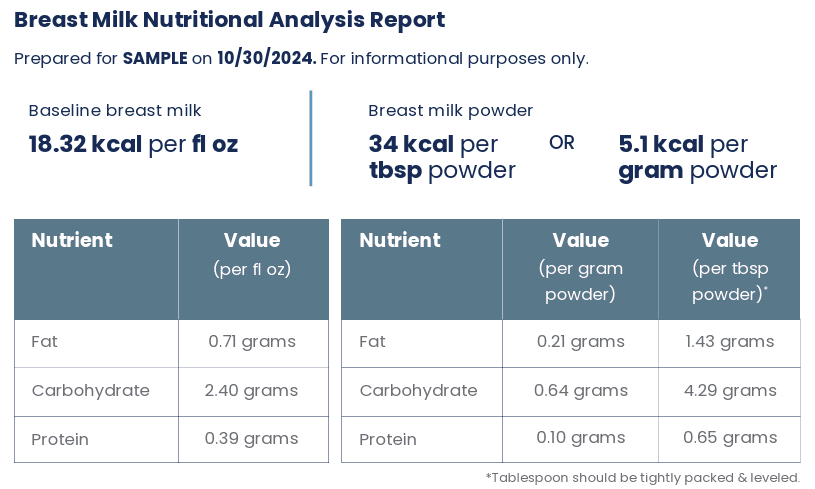
After placing an order through Milkify Medical and doing a consultation with our medical team, parents send a portion of their surplus frozen breast milk to Milkify, using one of our provided overnight shipping kits. Once received, the milk is freeze-dried, and samples of both liquid and freeze-dried breast milk are analyzed for macronutrient composition using the FDA-approved Miris Human Milk Analyzer.
The macronutrient analysis is then used by Milkify Medical's clinical team to develop an individualized fortification recipe guide to meet the caloric goals set by the infant's care team. The freeze-dried breast milk is then returned to the family along with the custom recipe and equipment for precise measurement of freeze-dried breast milk powder. The freeze-dried powder can then be easily mixed into the mother's own liquid breast milk according to the custom recipe guide in order to provide her baby with 100% Mom's Own Milk.
Learn more
See how the program works from consult to custom recipe, and what your baby's care team needs to get started.
About MOM Fortification→References
- Academy of Breastfeeding Medicine Clinical Protocol #36: The Mastitis Spectrum, Revised 2022
- Breastfeeding: Tips to Increase Your Milk Supply | University Hospitals | Northeast Ohio
- Breastmilk Production Pt II: Hand Expression | First Droplets on Vimeo
- CDC: Hand Expression handout
- Morton J, et al. Combining hand techniques with electric pumping increases milk production in mothers of preterm infants. J Perinatol. 2009
- Droplet (First Droplets) — Dr. Jane Morton
- Sinha B, et al. Effect of kangaroo mother care in low birth weight infants on human milk intake: a randomized controlled trial. Am J Clin Nutr. 2025
- Expressing breast milk by hand — Best Start in Life — NHS
- Mangel L, Ovental A, Batscha N, Arnon M, Yarkoni I, Dollberg S. Higher Fat Content in Breastmilk Expressed Manually: A Randomized Trial. Breastfeed Med. 2015
- Jayamala AK, Lakshmanagowda PB, G C M P, Goturu J. Impact of music therapy on breast milk secretion in mothers of premature newborns. J Clin Diagn Res (PMC). 2015
- Maximizing Milk Production | Newborn Nursery | Stanford Medicine
- Mohrbacher N. The Magic Number and Long-Term Milk Production. Clinical Lactation. 2011
- Normal prolactin levels in breastfeeding mothers — KellyMom.com
- Oxytocin: The love hormone — Harvard Health
About the author. Karen Miles is an International Board Certified Lactation Consultant (IBCLC) and Lactation Content Specialist with Milkify.
About the reviewer. Laura Serke is a Registered Dietitian and an International Board Certified Lactation Consultant (IBCLC) with Milkify.
This blog is for informational purposes only and is not intended to diagnose, treat, or be a substitute for medical advice. Please consult with your healthcare provider for any questions you may have related to your own health, or your baby's health, and do not change your baby's feeding plan without the recommendation of your baby's healthcare team. If you wish to request information about Milkify Medical MOM Fortification to give to your clinician to review, click here.
Have questions about MOM fortification?
Our medical team works with families and providers to build an individualized plan.
Request Info