From NG tubes to supplemental nursing systems to cups, here are devices that families have used since the program began, and what to know about each one.
One common question we get at Milkify Medical is: Does MOM Fortification* work with feeding devices other than bottles? The good news is:
“MOM Fortification has successfully been used with a variety of feeding devices, with no compatibility issues. There are currently no restrictions on the types of feeding devices that can be used.”
Milkify Medical's clinical team has supported numerous families in providing breast milk fortified with freeze-dried mother's own milk (MOM), using special feeding devices that have met their babies' feeding needs and family preferences. Listed and described below are feeding devices besides a bottle that we are aware of being used so far to feed MOM-fortified breast milk:
Nasogastric (NG), orogastric (OG), or gastric/gastrostomy tube (G-tube)
When a baby is not able to safely or sufficiently consume breast milk by mouth, their healthcare team may recommend feeding directly into the stomach through a feeding tube. For short-term feeding support, a nasogastric (NG) tube, which passes through the nose into the stomach, or an orogastric (OG) tube, which passes through the mouth to the stomach, is typically used. When longer-term tube feeding is needed, a gastrostomy tube (G-tube) which enters the stomach through the abdominal wall may be recommended.
MOM Fortification has been administered via NG/OG tubes in the NICU and in the home setting, including through tubes as small as 5 French (approximately 1.67mm in outer diameter, similar to the thickness of a piece of spaghetti). Feedings may be delivered through these tubes as an intermittent bolus or continuously, using a syringe pump or a feeding pump with a “bag set”. Some families use a combination of both methods, providing bolus feedings during the day and continuous feedings overnight as directed by their healthcare team.
Nasojejunal (NJ) or gastrojejunal/gastrojejunostomy (G-J) tube
When feeding by mouth or directly into the stomach causes complications, such as severe vomiting, aspiration, or delayed stomach emptying, the healthcare team may recommend feeding directly into the small intestine. This can be accomplished using a nasojejunal (NJ) tube, which passes through the nose, down the esophagus, through the stomach, and into the second portion of the intestine called the jejunum. Or alternatively, a gastrojejunal (G-J) tube may be used. This tube is placed through a small opening in the abdomen and typically has two channels (aka “ports”) – one channel going into the stomach (G-port), and the other running from that spot in the stomach and into the jejunum (the J-port).
Because the small intestine cannot hold larger feeding volumes as readily as the stomach, NJ and G-J tube feedings are typically administered slowly using a feeding pump, often over 16–24 hours per day. Delivering milk too quickly into the small intestine can cause feeding intolerance, including symptoms similar to dumping syndrome, such as abdominal cramping, diarrhea, and increased stool output. The feeding rate and schedule are individualized by the healthcare team based on the baby's nutritional needs and feeding tolerance.
Specialty feeder
Specialty feeders, such as Dr. Brown's Specialty Feeding System (SFS) and the Medela SpecialNeeds Feeder (formerly called the Haberman), have also been used to provide MOM-fortified breast milk. These feeders are designed for infants who may have difficulty with suction, pressure, or coordination and are not able to feed well from a standard bottle nipple. Babies who may benefit include those with cleft lip or palate, craniofacial abnormalities, low muscle tone, or neurological or neuromuscular conditions that affect sucking strength. The healthcare team can help determine which specialty feeder best meets your baby's individual feeding needs.
Finger feeding with a syringe
Finger feeding with a syringe is an alternative feeding method that may help babies practice suckling while receiving small volumes of breast milk, particularly those babies who have difficulty latching or are hesitant to feed at the breast. While it can be a way to supplement with small amounts of colostrum or milk, it is often not practical for larger feeding volumes. Families have reported providing MOM-fortified supplemental feedings to their babies using an ENFit syringe with a small flexible straw attachment. A syringe with a smooth “slip tip” may also be used for carefully controlled finger feeding, while a specialized syringe, such as a dental syringe, may be recommended for infants with cleft lip or cleft palate.
Milk should be delivered slowly and in response to the baby's suckling, rather than pushing the syringe plunger too quickly, which may increase the risk of coughing, choking, or aspiration. Babies should not be allowed to suck directly on the rigid syringe tip, as this can cause injury to the delicate tissues of the mouth. Families should receive guidance from their healthcare team on proper technique, positioning, and recognizing signs of feeding intolerance. (If you are not familiar with the concept of finger feeding with a syringe, watch IABLE's finger feeding demonstration.)
Supplemental nursing system (SNS)
A supplemental nursing system (SNS) may be beneficial for infants who require a specific feeding volume but are unable to sustain breastfeeding long enough to meet their nutritional needs. It may also be helpful for mothers whose milk supply is insufficient to meet their baby's feeding requirements.
When using an SNS, a small feeding tube is typically positioned at the mother's breast before the infant begins breastfeeding. The tube delivers supplemental milk, which may include MOM-fortified breast milk, unfortified maternal breast milk, donor human milk, or formula, while the infant is actively breastfeeding. (If you are unfamiliar with an SNS, here is an example.)
The additional milk flow provided through the SNS may encourage more vigorous and sustained suckling at the breast, potentially supporting maternal milk production through increased breast stimulation. This approach allows infants to continue breastfeeding while receiving supplemental nutrition to help meet their prescribed feeding volume and caloric goals.
An SNS may also reduce the need for separate feeding methods, such as breastfeeding followed by bottle-feeding or nasogastric (NG) tube supplementation, potentially making feeding sessions more efficient for families. Based on clinical experience, MOM-fortified breast milk appears to flow through the SNS as readily as unfortified maternal breast milk, donor human milk, or formula.
Milkify Medical's clinical team has received positive feedback from families of infants with cleft lip and/or cleft palate who have successfully breastfed using an SNS with MOM-fortified breast milk. In several reported cases, infants achieved greater total intake of MOM-fortified breast milk using an SNS compared with bottle-feeding. Although these observations are based on individual clinical experiences, they highlight the potential role of an SNS in supporting breastfeeding and nutritional intake for infants with specialized feeding needs.
Neotech Bridge
Like a nipple shield and supplemental nursing system in one, the Neotech Bridge allows for milk flow control by the parent while the baby is at the breast, while encouraging the baby to go to the breast for nourishment. We have worked with families whose babies are preterm or have a cleft lip and/or cleft palate use the Neotech Bridge to receive caloric MOM Fortification while at the breast.
Cup feeding
A young breastfed baby who is having trouble breastfeeding can receive breast milk with MOM Fortification using a very small cup. Traditional cup feeding of young infants is done with a small medicine cup, a Foley cup, or equivalent as recommended by their healthcare team. When cup feeding, babies extend and curl their tongue to lap up milk, similar to how a kitten drinks. Parents should make sure their baby is alert and positioned upright or semi-upright on a parent's lap to reduce the risk of aspiration. To help catch spills, putting a bib on the baby or a washcloth under the chin may be helpful. Gently covering the baby's hands with a blanket can also prevent spills. In addition, lining up several small medicine cups or Foley cups in advance, if intake is anticipated to be more than an ounce or two, can make the feeding process more efficient. (If you are not familiar with the concept of cup feeding, watch IABLE's cup feeding demonstration.)
Compared with cup feeding, our clinical team more commonly hears from parents of newborns who are finger feeding MOM-fortified breast milk with a syringe. Perhaps because parents (and providers) often consider it less messy than cup feeding a young baby! However, cup feeding is an option at a young age if the healthcare team and parents desire it, and if the baby is receptive. As babies develop the skills to drink from a cup, typically beginning around 6 months old, they may be introduced to a sippy cup or straw-training cup with a caregiver assisting. Milkify Medical's clinical team has also supported families with older babies who are receiving cup feedings of MOM-fortified breast milk.
The list keeps growing
The list of feeding devices that our clients have effectively used with MOM Fortification just keeps growing and growing! We're sure to hear from parents feeding MOM-fortified breastmilk to their babies via many other types of feeding devices in the not-so-distant future.
*What is Milkify Medical “MOM Fortification”?
Milkify Medical's MOM Fortification program offers 100% human milk-based caloric fortification for infants greater than 1800g (4 pounds) using the mother's own surplus freeze-dried breast milk as a caloric fortifier for freshly expressed breast milk. Parents may choose MOM Fortification out of a desire to support their baby's growth while providing exclusively their own breast milk, and avoiding the tolerance issues that can sometimes be associated with cow's milk based formulas and fortifiers.
How does it work?
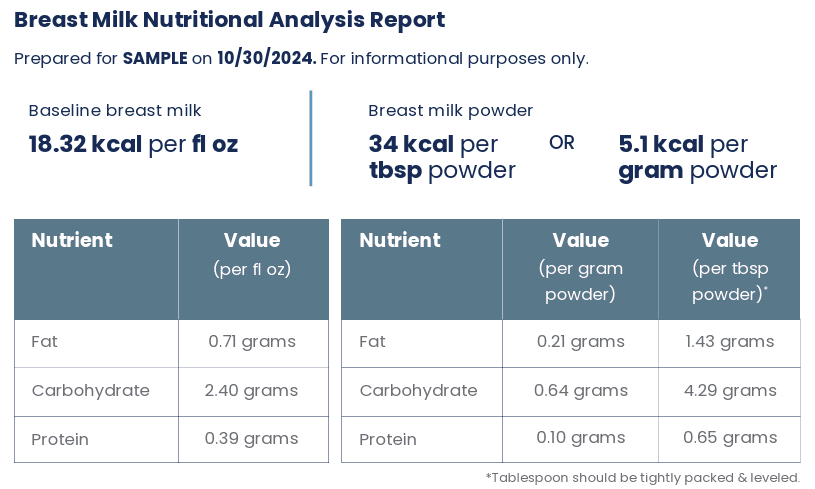
After placing an order through Milkify Medical and doing a consultation with our medical team, parents send a portion of their surplus frozen breast milk to Milkify, using one of our provided overnight shipping kits. Once received, the milk is freeze-dried, and samples of both liquid and freeze-dried breast milk are analyzed for macronutrient composition using the FDA-approved Miris Human Milk Analyzer.
The macronutrient analysis is then used by Milkify Medical's clinical team to develop an individualized fortification recipe guide to meet the caloric goals set by the infant's care team. The freeze-dried breast milk is then returned to the family along with the custom recipe and equipment for precise measurement of freeze-dried breast milk powder. The freeze-dried powder can then be easily mixed into the mother's own liquid breast milk according to the custom recipe guide in order to provide her baby with 100% Mom's Own Milk.
Learn more
See how the program works from consult to custom recipe, and what your baby's care team needs to get started.
About MOM Fortification→References
- Breastfeeding Education by IABLE | Finger Feeding to Supplement a Breastfeeding Infant | IABLE
- Breastfeeding Education Videos | Cup Feeding Breast Milk to an Infant | IABLE
- Cup Feeding | Foley Cup Feeder
- Cup Feeding Infants During Emergencies | Infant and Child Feeding in Emergencies | CDC
- Early Postpartum | Supplemental Nursing System (“SNS”) | Physician Guide to Breastfeeding
- Fingers, Spoons, Forks, and Cups | Infant and Toddler Nutrition | CDC
- How to Cup Feed | Foley Cup Feeder
- Neotech Bridge® Breastfeeding Assistance Device | Neotech Products
- Tools for Feeding: Bottles & More | KellyMom.com
About the authors: Laura Serke is a Registered Dietitian and an International Board Certified Lactation Consultant (IBCLC) with Milkify. Karen Miles is an International Board Certified Lactation Consultant (IBCLC) and Lactation Content Specialist with Milkify.
This blog is for informational purposes only and is not intended to diagnose, treat, or be a substitute for medical advice. Please consult with your healthcare provider for any questions you may have related to your own health, or your baby's health, and do not change your baby's feeding plan without the recommendation of your baby's healthcare team. If you wish to request information about Milkify Medical MOM Fortification to give to your clinician to review, click here.
Have questions about MOM fortification?
Our medical team works with families and providers to build an individualized plan.
Request Info